The Shape of a Country Day: Loop, Out-and-Back or One Way
Choose a country day route by weighing distance, return transport and the pace you want, so villages and walks fit the day without a rushed finish.
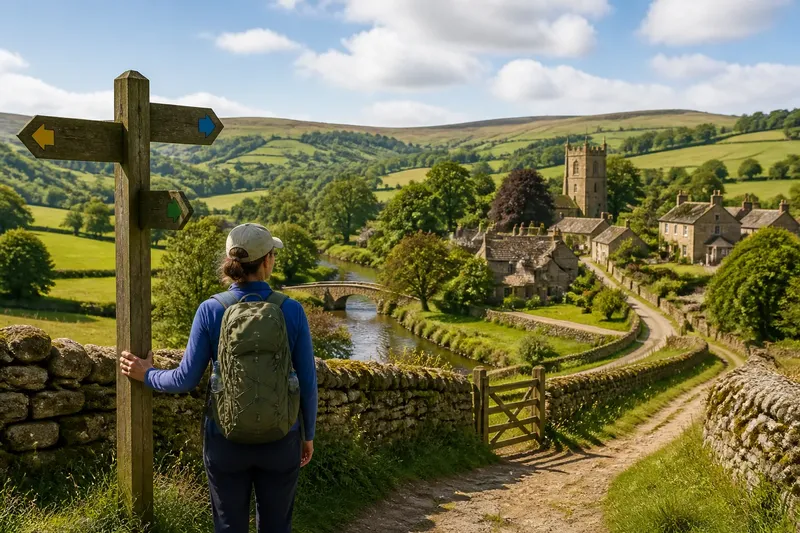
The common mistake with a country day route is choosing the prettiest line on the map before asking how you will get back. That can leave a pleasant walk ending at a quiet lane with no bus, or turn a relaxed village visit into a hurried return. A loop, an out-and-back and a one-way journey each shape the day differently; the useful choice is the one that fits both the landscape and your return arrangements.
Think of route shape as a way to organise attention, not merely distance. A loop brings you back by another way, an out-and-back retraces a familiar stretch, and a one-way route carries you towards a separate finishing point. Each can suit a memorable day, provided you decide what should happen at the end before setting off.
Start with the ending you want
Before tracing a line, picture the final hour. Do you want to arrive back at your car and drive home, finish beside a station, or return to the same village for a meal? That small decision can settle the route shape more reliably than a list of attractions.
Then consider how much of the day you want to spend moving. A route with several stops needs slack for a churchyard gate, a farm shop queue or a conversation at a village noticeboard. If walking itself is the main pleasure, fewer scheduled stops may make the day feel generous rather than empty.
- Choose a loop if you want changing scenery and need to return to one starting point.
- Choose an out-and-back if a particular destination matters more than seeing new ground all the way.
- Choose one way if a reliable onward connection lets you finish somewhere different.
These are starting points, not rules. A short loop can feel more demanding than a longer out-and-back if it includes rough paths, steep lanes or several stops that take longer than expected.
A loop makes the return part of the day
A loop is appealing when you want variety without arranging separate transport at each end. It might link a market-town edge, a footpath beside a stream and a neighbouring hamlet before bringing you back to the same car park or bus stop. The return is built into the route rather than treated as a second journey.
Its main pleasure is a sense of progression: hedgerows change, views open, and the route can pass through a different set of lanes on the way back. But loops can be awkward if a mapped right of way is unclear or if the final stretch follows a busy road. Check that the connection between paths is actually usable, rather than assuming every thin line on a map is a pleasant walking route.
Loops also make a flexible day easier to improvise. If a café is closed or rain settles in, you can shorten the outing by turning towards the start, as long as the paths allow it. Leave room for the route to change; a loop need not be an exact figure traced with unbending precision.
An out-and-back lets one place hold the day
An out-and-back suits a destination with enough interest to justify arriving and staying: a riverside footbridge, a village with a small local museum, or a lane leading to a viewpoint. You travel along the same corridor in both directions, but it need not feel like a repeated performance. On the return, the light, weather and your attention may have shifted.
This shape is useful when transport options are limited and you need to finish where you began. It also lets you set a clear turning point. Rather than pressing onwards because the map suggests more ground, you can make the destination a natural pause for lunch, a sketch or a look around.
The trade-off is that the route back can feel long if the outward stretch is monotonous or exposed. Look for small ways to vary the experience without complicating it: walk on the opposite side of a broad track where appropriate, pause at a different point, or save a village shop visit for the return. The purpose is not to disguise the route, but to give the day a rhythm.
One way works when the return is already solved
A one-way route is often the most satisfying choice when public transport connects the start and finish. You might begin at a railway station, walk through farmland and two villages, then finish near a bus stop or another station. It can make the landscape feel like a journey through places rather than a circuit designed around a car.
Yet the transport link is part of the route, not a footnote. Check the service for the day you plan to travel, identify a practical alternative if the connection is missed, and leave enough time to reach the stop without racing through the final village. If the timetable is sparse, the day should be planned around the departure you can realistically catch.
One-way travel can also work with a lift or two-car arrangement, but be clear about who is waiting where and when. Keep the meeting point specific: a named station entrance or a public car park is easier to coordinate than “somewhere near the centre”. The less certain the return, the more useful a route that ends where it began.
How do you match the route to the day?
Which route shape is easiest without a car?
A one-way route can be convenient if buses or trains serve both ends and their times suit your pace. A loop may work better if one settlement has dependable transport, while an out-and-back keeps the start and finish together.
Is an out-and-back less interesting than a loop?
Not necessarily. A destination with a changing view, a riverside path or a welcoming village stop can give the outward and return journeys different purposes. Choose it when the place at the far end matters more than the novelty of every mile.
How should I plan a route with village stops?
Pick one or two stops that genuinely interest you, then allow the rest of the day to remain open. Check likely opening arrangements for any place you hope to enter, and treat a closed door as a reason to enjoy the street, landscape or walk instead.
What if the weather changes during the day?
Prefer routes with sensible places to pause or leave early, such as a village shop, a bus stop or a path back to the starting point. Look at the forecast and local path information before leaving, and avoid pressing on when conditions make the route unsuitable.
Give the day a simple rhythm
A country day benefits from a loose sequence rather than a timetable packed with appointments. Decide what you want to do at the start, where the main pause might fall, and what would make you shorten the journey. Then let village life set some of the pace: a market stall may be packing up, a church may be open, or a lane may simply invite a slower walk.
Say you are staying in a village and want to visit a neighbouring hamlet before returning for supper. Imagine the bus back runs only at a time that leaves little room for delay, while a footpath makes a clear loop to your starting point. You could choose the loop, keep the hamlet as the main pause, and leave the bus out of the return plan; the observable benefit is a day whose ending is not dependent on a tight connection. If the loop crosses uncertain paths, the more dependable out-and-back may be the better fit.
It is not worth spending an evening trying to make a route trace a perfect circle or squeezing in every nearby landmark. A route can be lopsided and still feel complete. What matters is whether its ending, walking conditions and pauses suit the day you actually want.
Check the practical details before setting off
Before you commit, look over a map and the relevant transport information, then make a small plan for the return. Check these points:
- Start and finish: Can you reach the starting point easily, and will you finish where you expect?
- Path connections: Do the walking routes join up, and are there gates, crossings or road sections to account for?
- Return transport: If the route is one way, does the service run on your chosen day, and is there a workable fallback?
- Stops: Which village or feature is the reason for going, and can you still enjoy the day if a venue is closed?
- Conditions: Is the route suitable for the weather and your group, with a sensible way to shorten it?
- Time to linger: Have you left room for a meal, a slow stretch of lane or an unplanned pause?
For path access, transport rules and opening arrangements, follow the relevant land manager’s, operator’s or venue’s current information. These details can change, so check the source closest to the place or service rather than relying only on an old map note.
The best country day route is the one whose shape gives the day a satisfying finish. When weighing up a country day route, choose the loop for varied ground and a shared start and finish, the out-and-back for a destination worth revisiting, or the one-way journey when the onward link is dependable. With the return settled, you can pay attention to the small particulars that make the day yours: a lane’s changing light, a village shop, or the quiet stretch between them.